Disaster Preparedness and Response

- Croatian Red Cross is integral part of the protection and rescue system of the Republic of Croatia.
- It prepares disaster response units on local and national level and informs citizens of all ages about correct procedures and behaviour in emergencies.
- Croatian Red Cross participates in all the activities linked to crises, during all phases – from preparedness activities to response and recovery phase.


Make a plan
Determine a contact person, who does not live in your settlement, through which you can connect with other family members in case you are separated. Arrange an exact meeting place, with your family members, in the event of a disaster in which you will be found if communication is interrupted. This place must be well-known to all family members, it must not be too close or far from the location of any accident (up to 7 to 10 km) and must be sufficiently safe for all family members.
Be informed
Get acquainted with the potential crisis situations that may occur in your area. Get acquainted with established measures and plans of security and protection. Be able to take personal and mutual protection measures to be able to react before the emergency services and operational forces of protection and rescue come to the scene. Get a transistors radio so you can get instructions from relevant institutions about taking protective measures, as well as other information that can help you protect yourself and mitigate possible consequences. Find out before the crisis situation what are the fastest evacuation routes, to be ready to respond quickly and without thinking to evacuate yourself and your family. At the same time ensure that all household members are familiar with the same routes.
Pack an emergency supply kit
At Least a 3-day Supply of Food and Water
- Water – one gallon per person, per day
- Food – foods that are easy to make and won’t spoil, like canned soup, dry pasta, and powdered milk
- Manual can opener
- Basic utensils to prepare and serve meals
Are You Prepared?
Health Supplies
- 3-day supply of all medicines, at a minimum
- Medical supplies like syringes, a walking cane, or hearing aids with extra batteries
Personal Care Items
- Soap
- Toothbrush and toothpaste
- Baby wipes
- Contact lenses or glasses
Safety Supplies
- First aid kit
- Emergency blanket
- Multipurpose tool (that can act as a knife, file, pliers, and screwdriver)
- Whistle
Electronics
- Flashlight
- Radio (battery-powered, solar, or hand-crank) for updates on the situation
- Cell phone with chargers
- Extra batteries
Documents
- Copies of important documents such as insurance cards and immunization records
- Paperwork about any serious or on-going medical condition
- Your completed family emergency plan, complete with family and emergency contact information.
You should also include:
- Extra cash
- Maps of the area
- Extra set of car keys and house keys
Take Care of Others
Every family is unique. You may have emergency needs not included in this list. Also, remember to update your kit according to changing needs of your family.
For Children
- Baby supplies like bottles, formula, baby food, and diapers
- Games and activities for children
For Pets
- Food and Water
- A 3-day supply of food and water for each pet. A cat or a dog will generally need 1 gallon for three days.
- Bowls or bottles
- Manual can opener
- Cleaning Supplies
- Depending on the pet, you may need a litter box, paper towels, plastic trash bags, grooming items, and household bleach
- Health and Safety
- Medicines and medical records stored in a waterproof container
- First aid kit with a pet first aid book
- Transport supplies
- A sturdy leash, harness, and carrier to transport pets safely. A carrier should be large enough for the animal to stand comfortably, turn around, and lie down. Your pet may have to stay in the carrier for several hours.
- Comfort Items
- Pet toys and the pet’s bed, if you can easily bring it, to reduce stress
- Paperwork
- Current photos and descriptions of your pets to help others identify them, and to prove that they are your pets, in case you become separated from them
- Information on feeding schedules, medical conditions, behavior problems, and the name and telephone number of your veterinarian in case you have to board your pets or place them in foster care
Quick Tips
- Keep it fresh. It’s extremely important that all items in your kit are functional at the time of an emergency.
- Check the expiration dates on food, water, medicine, and batteries at least two times per year.
- Replace any food or supplies that may have expired.
- Be sure it’s ready to use. In a disaster situation, you may need to get your emergency supply kit quickly, whether you are sheltering at home or evacuating.
- Once you have gathered your supplies, pack the items in easy-to-carry containers.
- Clearly label the containers and store them where you can reach them easily.
- Remember that certain items, like medications and paper documents, need to be kept in waterproof containers.
- Involve children. Families can make emergencies less stressful by preparing in advance and working together as a team.
- Ask your kids to think of items that they would like to include in an emergency supply kit, such as books, games, and pre-packaged foods.
- Your kids can mark the dates on a calendar for checking emergency supplies. Tell them to remind you when it’s time to check the supplies.
- Include kids in planning and creating disaster kits for family pets.
- Know your house. Find out where your gas, electric, and water shut-off locations are, and how to turn them off.
- Prepare for everywhere. Emergencies can happen anywhere. Remember to prepare supplies for home, work, and vehicles.
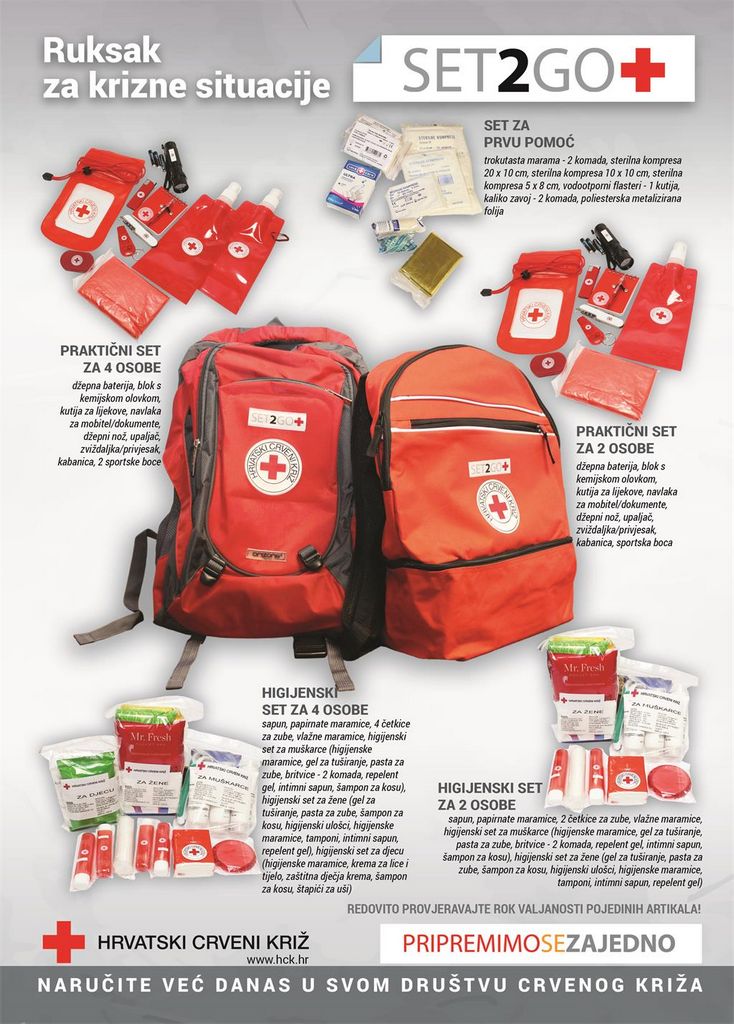
Backpack for crisis situations
SET2GO: prepare for crisis situations.